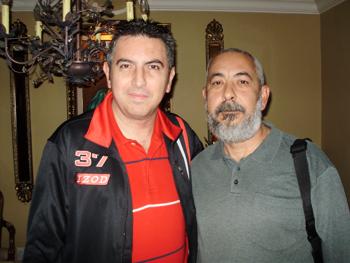
Pictured: Padura (right) with the reporter Wilfredo Cancio, Miami
As part of sharing initiatives cultural exchange between Cuba and the United States, the writer Leonardo Padura was the invited keynote speaker "at the University of North Carolina (Chapel Hill), where he held a conference on the relationship between travel and literature. Not surprisingly, then, that Padura began his presentation with an apostille embracing these new measures of cultural exchange and placement of not a few American universities to their work. "The U.S. academy is critical not only for my work, but to the work of many Cuban writers," said Padura left with an overwhelming sincerity. While happiness flowed from his eyes, as he commented that his visit to Chapel Hill was just the beginning of a whole plan Map by different departments of literature in the United States (...)
Padura's conference was entitled "La Habana our daily", and sought review in one hour colloquial, the history of the Cuban capital through literature. Among the historical essays and travel narrative, Padura tied ropes from the origin of Cuban literature until the beginning of his novels. (...) I opened by mentioning Fraginals Manuel Moreno and his book Cuba / Spain , and at times, one would have the idea that the conference would be the sea, and it stopped about fifteen minutes on the bay, colors of the sea and historiography Havana's colonial trade. For Padura the sea symbolized the entrance of the city and its colors. However, is not it also the sea leaving the country? Is not the sea, escape the raft, or manufacture of an invasion of America? At no time mentioned, I write in my notes, which also embodies the terror and sublime sea convulsed Marti "I Hate the Sea" or rafts of Luis Cruz Azaceta shipwrecked in the Gulf Stream
.(...) Padura
fails to address the political issue. Adages repeated in the manner of "social problems", "cultural differences", "opposing views", "dilemmas racism ', but fails to delve into the root of the problem, if we speak of the modern city of Havana, is found in the cultural-political role of the island (...)
The other stop on this course genealogical the city is Tres Tristes Tigres of Cabrera Infante. Novel to Padura, marks another rhythm of the city, where rides on American cars, American novels are read, they speak English, and encourage their nights in Havana nightclubs. Cabrera Infante's Havana is the place where they mix the languages, warns Padura, and concluded, "That is the most merit: having built the language of Havana." But stop. At no time Padura tells us what kind of language is concerned, or perhaps you can explain a city under the banner of a single monolithic "habanero language." In any case, Cabrera Infante de Padura, (...) is a writer who says little or nothing about politics or cultural mechanisms for the terminal phase of revolutionary Havana.
And it is curious that most expect when the conference Padura, it goes to the Cuban Revolution, is precisely where we found a plateau of loneliness, a void of proper names and literary works (...) and needs to be go to record a few names of writers dead or margins of Cuban culture. For example, go afloat names Jesus Diaz, Lisandro Otero, Edmundo Desnoes, Humberto Arenal, Reinaldo Arenas and Pedro Juan Gutiérrez . Writers who, according Padura, have returned to Havana where the point is lost illusions and the daily struggle of man against his environment. (...) If ruins and talked politics, how is it possible that Padura ignore the stories and the novel The Feast Probation of Antonio José Ponte ? But perhaps tackle a story like "The Art of Making Ruins" Padura force to politicize his speech, which, since the beginning of his talk, tried to isolate all possible means. After finishing his speech, Padura left him even more clear: "I'm not political, I do not imagine the future of Cuba."
to silence the Cuban writers of the nineties and the last ten years, Padura repeated the gesture of the Cuban government policy, which opposes continuously within a binary rule, writers of the island and in exile. Hence, apart from a brief and enigmatic mention Abilio Estévez ("My friend Abilio, Tusquets also a published writer, who now lives in Barcelona," said Padura with affection), the exiled Cuban writers conspicuous by their absence, and had contained had passed away (Cabrera Infante, Arenas, Novas Calvo, Diaz). Karla Suárez mentions, Reveron Rogelio or Pedro Juan Gutierrez, leaving aside writers Daína Chaviano, Antonio José Ponte or Orlando González Esteva that from the novels, essays or poetry, have offered key readings on the city .(...).
Asked Leonardo Padura, after finishing his speech, if he saw any difference in the representation of the city between the scriptures produced within and outside Cuba, the author of stations, called for a "literature of the unit." He replied with a rhetorical question in the best Anglo-Saxon sense, "Boy, look, no, no difference. Is a Cuban literature. Think of Celia Cruz, Cuban is there anything else she? ". (...).
One of the surprises that we get the author's Havana was his answer to another question from the audience, in which the writer vehemently defended English publishers (Anagram, Tusquets, Planet, Alfaguara) that maintain a monopoly Latin American publications. According Padura, the market is the only form of unity between writers. (...) The Padura speech made visible the operation of organic writer Cuba today. Ideologies do not matter, the Revolution, good or evil, it is important to be visible in the market and find there, hopefully in the academies, the patronage he could not provide the cultural support of the revolutionary state.
Gerardo Muñoz is a graduate of University of Florida.
Fragments of a article published in Cuba Meeting.


0 comments:
Post a Comment